
Saúl Recinas López, Instituto de Investigaciones Sociales – UNAM. Instagram: @saul_erreele
Fecha de captura: Julio a Octubre de 2023, Ciudad de México, México.


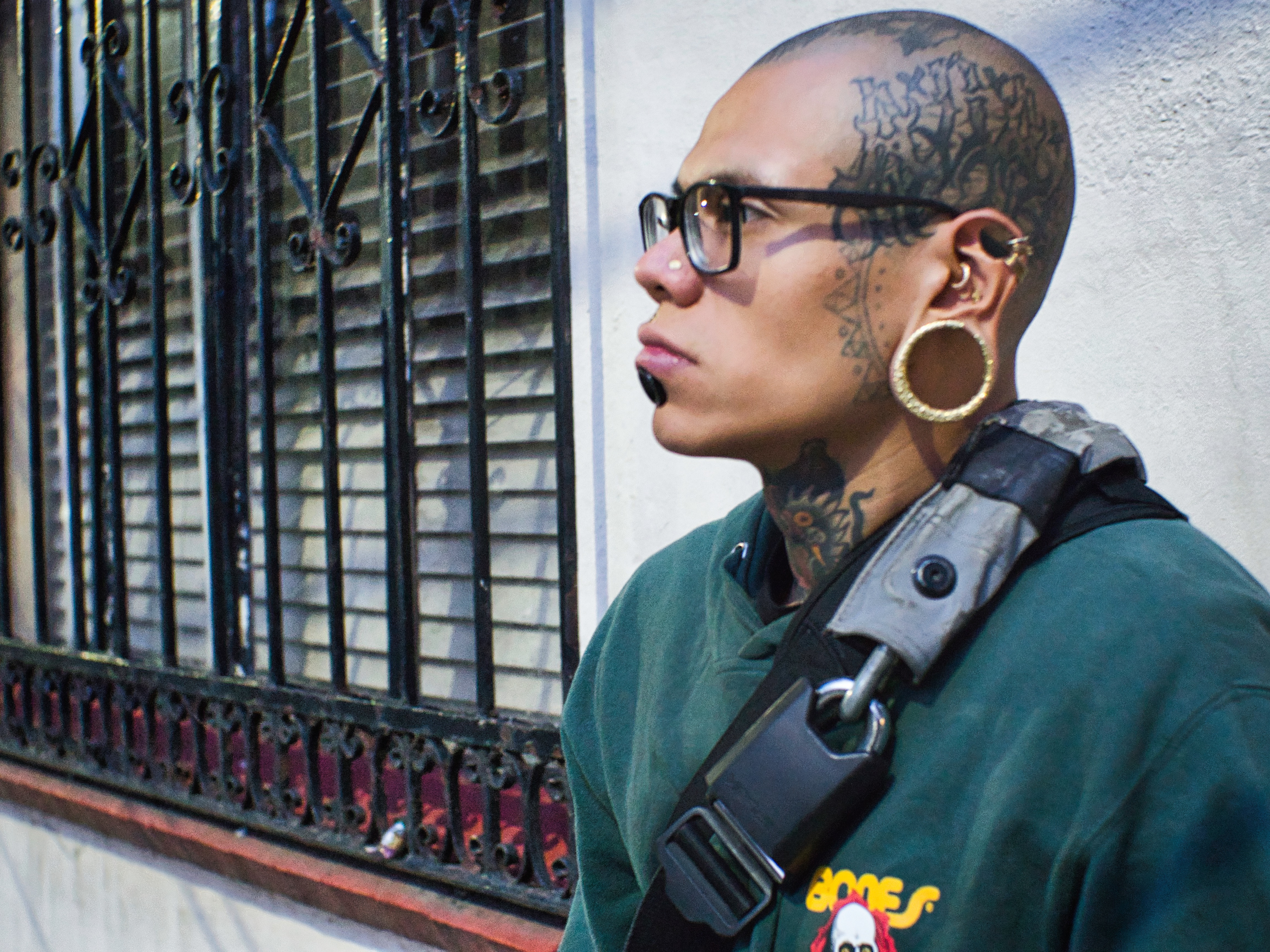

Nombre de las fotos: Entrevista con informante 1, julio de 2023. Entrevista con informante 10, octubre de 2023. Entrevista con informante 11, octubre de 2023. Entrevista con informante 2, julio de 2023. Visita de observación, julio de 2023.
Uno de los elementos centrales de la época contemporánea se refiere a las amplias posibilidades que el mercado cultural brinda a las y los individuos para la constitución de subjetividades y la modificación corporal. En este contexto, prevalece un discurso en el que se da por sentada una aparente apertura moral sobre las distintas prácticas de configuración estética. Este discurso, no sólo insinúa la aprobación, sino que, además, construye una idea de igualdad de condiciones para las personas de distintos sectores sociales. Sobre este plano, el presente proyecto explora en qué medida el tatuaje, como práctica estética, contribuye a la configuración de representaciones e imaginarios sobre la otredad, o, en otros términos, a la negativización y fijación de ciertas subjetividades construidas como otras, que contribuyen a legitimar la desigualdad social. Este trabajo constituye un esfuerzo por articular la sociología del estigma y la sociabilidad urbana, con las estéticas corporales y la portación de tatuajes como marcadores de reconocimiento y desprecio, dependiendo del “cuerpo” de quien lo porta. Asimismo, da cuenta de la manera en que se experimentan en situaciones concretas problemáticas relacionadas con la conformación de representaciones sobre “los otros” y cómo ello, en algunas instancias, puede derivar en la legitimación de estigmas.
¿Por qué son importantes estas fotografías en particular para su investigación?
Las fotografías son centrales para esta investigación en tanto permiten visibilizar diversas estéticas en las que el tatuaje cobra centralidad pero que no es el único elemento por considerarse, es decir, también se observan “los cuerpos” que portan dichos tatuajes. Debo destacar que la fotografía cobra importancia para la presente investigación en dos líneas. La primera, porque se convierte en un analizador sobre la configuración estética, como he mencionado anteriormente. En segundo lugar, porque en términos metodológicos se ha utilizado la fotografía comentada, esto es, durante las entrevistas se muestran imágenes en las que diversas personas portan tatuajes. La intención de ellos es que las y los informantes expongan su percepción en torno a lo que observan las imágenes. Este acercamiento ha permitido analizar la configuración de mapas mentales y percepciones en torno a distintas estéticas que, en última instancia, muestran la constitución de estructuras sobre lo que está o no “bien” visto o aceptado.
Body aesthetics, otherness and stigmas
Saúl Recinas López, Instituto de Investigaciones Sociales – UNAM. Instagram: @saul_erreele
Date: July to October 2023, Mexico City, Mexico.
Name of picture: Interview with informant 1, July 2023. Interview with informant 10, October 2023. Interview with informant 11, October 2023. Interview with informant 2, July 2023. Observation visit, July 2023.
One of the central elements of the contemporary era refers to the broad possibilities that the cultural market offers individuals for the constitution of subjectivities and body modification. In this context, a discourse prevails in which an apparent moral openness regarding the different practices of aesthetic configuration is taken for granted. This speech not only hints at approval, but also builds an idea of equal conditions for people from different social sectors. On this level, the present project explores to what extent tattoo, as an aesthetic practice, contributes to the configuration of representations and imaginaries about otherness, or, in other words, to the negativization and fixation of certain subjectivities constructed as others, which contribute to legitimize social inequality. This work constitutes an effort to articulate the sociology of stigma and urban sociability, with body aesthetics and the wearing of tattoos as markers of recognition and contempt, depending on the “body” of the wearer. Likewise, it accounts for the way in which problematic situations related to the formation of representations about “others” are experienced in specific situations and how this, in some instances, can lead to the legitimation of stigmas.
Why are those particular photographs important to your research?
The photographs are central to this research as they allow us to visualize various aesthetics in which the tattoo becomes central but is not the only element to be considered, that is, “the bodies” that carry said tattoos are also observed. I must highlight that photography becomes important for this research in two lines. The first, because it becomes an analyzer of the aesthetic configuration, as I mentioned previously. Secondly, because in methodological terms the commented photography has been used, that is, during the interviews images are shown in which various people have tattoos. Their intention is for the informants to express their perception of what they observe in the images. This approach has allowed us to analyze the configuration of mental maps and perceptions around different aesthetics that, ultimately, show the constitution of structures about what is or is not “well” seen or accepted.
 Narrativas Visuales/Visual Narratives